On this page
Finding water on the laundry room floor is stressful, but the puddle itself is a useful clue. Where the water appears, and at which point in the cycle, usually tells you which part of the washer is leaking. Some causes take a minute to fix with no tools at all; others need a technician.
This guide shows how to read the puddle, what you can safely check yourself and which signs mean it is time to call for help.
First, Stop the Water and Stay Safe
Water and electricity do not mix. Before you look for the leak:
- Stop the cycle and unplug the washer, but only if the plug and the floor around the outlet are dry. If water has reached the outlet, turn off the circuit breaker first.
- Turn off both water faucets behind the washer, usually a hot and a cold valve on the wall.
- Dry the floor completely with towels. You need a dry starting point to see where new water comes from.
Make Sure It Is Really the Washer
Before taking anything apart, rule out the things nearby. A water heater, a utility sink, the drain standpipe or a pipe in the wall can all leave water that looks like a washer leak. Condensation on cold supply hoses in humid weather can also drip onto the floor. Run a quick check: with the washer off, put a dry paper towel under each nearby pipe and fitting and look again in an hour.
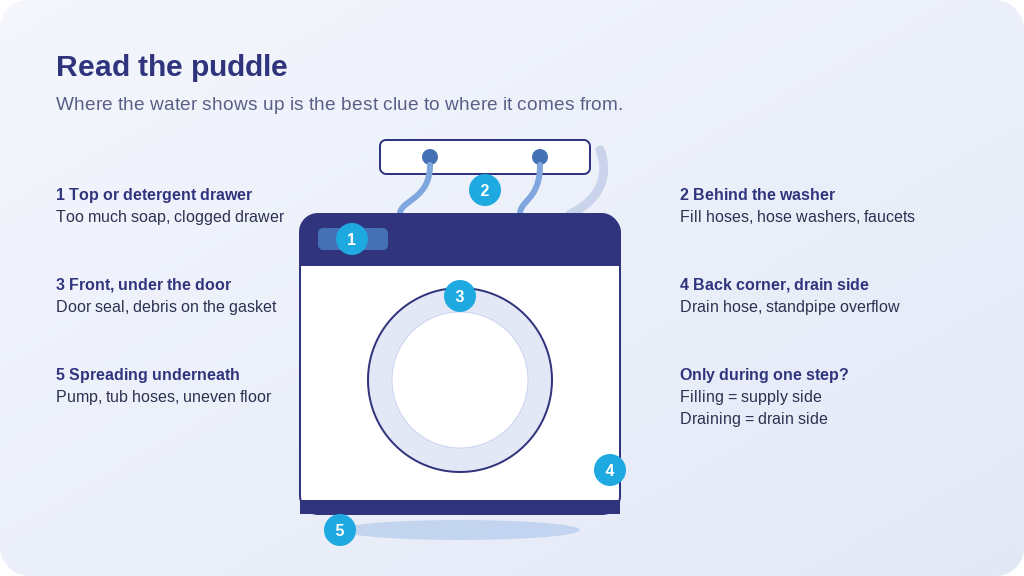
Read the Puddle: Where the Water Comes From
| Where you see water | Likely source | What you can check |
|---|---|---|
| Top of the washer or around the detergent drawer | Too much detergent, wrong detergent type, a clogged drawer or dispenser | Clean the drawer and its housing, use the right amount of HE detergent |
| Behind the washer | Fill hoses, the rubber washers inside the hose ends or the wall faucets | Tighten the connections by hand, check the hoses for cracks or bulges |
| Front, under the door (front-loaders) | The door seal, also called the boot or gasket | Wipe the seal, remove hair, lint and small items, look for tears |
| Back corner on the drain side | Drain hose, its clamp or an overflowing standpipe | Check that the hose is secure and the standpipe drains freely |
| Spreading from underneath | Drain pump, internal hoses or the tub seal, sometimes an unlevel washer | Check leveling; internal parts need a technician |
Timing Matters Too
Watch one empty cycle from start to finish with a flashlight, and note when the water appears.
- While the washer fills, the leak is almost always on the supply side: the fill hoses, the inlet valve or the detergent dispenser.
- During washing or tumbling, look at the door seal on a front-loader, or suds escaping on any washer when there is too much detergent.
- While the washer drains or spins, the drain side is the main suspect: the drain hose, the standpipe, the pump or the hoses connected to it.
- When the washer is not running at all, water is probably coming from a faucet or fill hose that is under constant pressure.
Checks You Can Safely Do Yourself
Inspect the fill hoses
Pull the washer out carefully and look at both hoses along their full length. Hand-tighten the connections at the faucets and on the back of the washer. If a connection still drips, the small rubber washer inside the hose end may be flattened or missing. Replace any hose that is cracked, bulging or more than about five years old. Braided stainless steel hoses are a common upgrade, but whichever type you have, check them once a year.
Clean the door seal on a front-loader
Open the door and pull back the folds of the rubber seal. Socks, coins, hair ties and lint get trapped there and hold the seal open just enough to drip. Wipe it clean and dry, and look closely for small tears or holes, especially at the bottom. A torn seal needs to be replaced; tape or glue will not hold.
Use the right detergent, and less of it
Most modern washers are high-efficiency models that need HE detergent, and only a small amount of it. Regular detergent or too much HE detergent creates excess suds that can push water out of the drawer, the door or the vents. If you see foam where the water is, run a rinse cycle with no detergent and cut back on the next loads. Clean the detergent drawer and the opening it slides into, where residue often builds up.
Check the drain hose and standpipe
The drain hose should be firmly secured in the standpipe or sink, not pushed in too deep, and its clamp should be tight. If water comes out of the top of the standpipe while the washer drains, the problem is usually a slow drain line in the house rather than the washer itself.
Level the washer
A washer that rocks or walks across the floor can shift its hoses and slosh water past the seals. Place a level on top and adjust the front feet until it sits flat and steady, then tighten the lock nuts.
When to Call a Technician
Some leaks come from parts inside the cabinet, where repairs need the right tools and replacement parts. Call a technician if:
- Water comes from underneath and you cannot see a hose or loose connection.
- The leak shows up during draining or spinning and the drain hose and standpipe look fine.
- The door seal is torn, or the washer leaks from the front even after cleaning the seal.
- You hear grinding or loud noises along with the leak, or see rust or water stains under the tub.
- The washer does not stop filling, even when it is turned off.
Until then, keep the faucets turned off between loads. A small leak can damage flooring and the subfloor over time, so it is worth finding the cause early.
Habits That Help Prevent Leaks
- Check the hoses and connections once a year, and replace old hoses before they fail.
- Use HE detergent in the amount the label recommends for your load size.
- Wipe the door seal after the last load of the day and leave the door open to dry.
- Do not overload the drum, which strains the door seal and the suspension.
- Leave a few inches of space behind the washer so the hoses are not kinked or crushed.
If you cannot find the source or the leak is coming from inside the washer, AceTech technicians can take a look. We serve homes across Sacramento, Fair Oaks, Roseville, Folsom, Davis and the East Bay.