
On this page
You open the dishwasher to unload clean plates and get hit by a sour, musty or rotten-egg smell. It is one of the most common dishwasher complaints, and the good news is that in most cases it has nothing to do with a broken part. A smelly dishwasher is usually a dirty dishwasher: food particles, grease and standing water collect in places you never see during normal use.
This guide shows where the odor comes from, how to deep clean a dishwasher step by step with simple supplies, and which habits keep the smell from coming back.
Why Dishwashers Start to Smell
A dishwasher spends its whole life dealing with food residue, warm water and moisture. Most of the debris goes down the drain, but some of it gets trapped. Over a few weeks, that trapped residue starts to break down, and bacteria and mold grow in the damp, closed space. The result is a smell that gets stronger every time the door stays shut between loads.
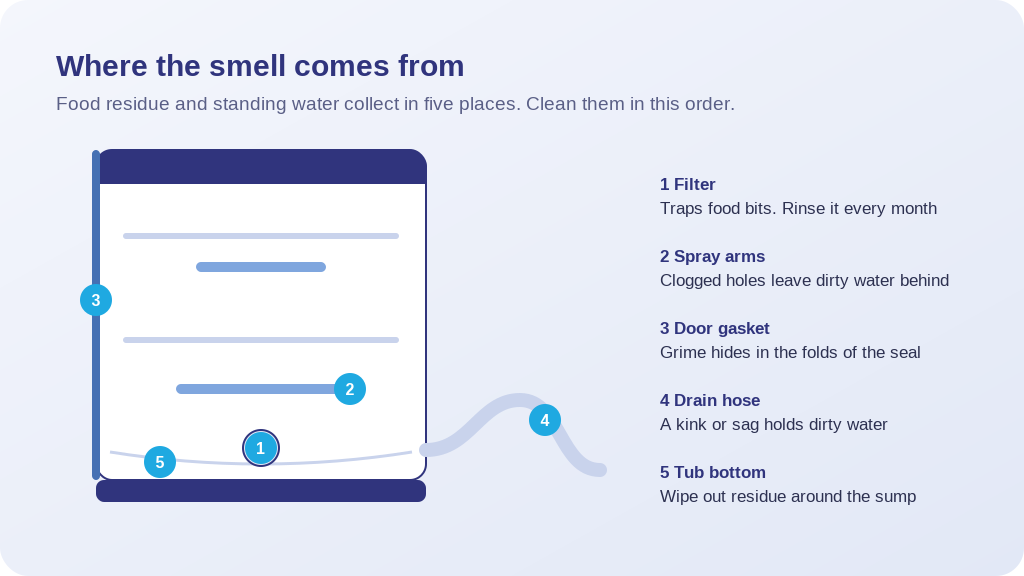
The most common sources are:
- A dirty filter. Most modern dishwashers have a manual filter at the bottom of the tub that needs regular cleaning. Many owners do not know it exists.
- Food stuck in the spray arms, which blocks the jets and leaves greasy water behind.
- Grime in the door gasket and along the bottom edge of the door, where water and crumbs collect.
- Standing water in the bottom of the tub after the cycle ends.
- The drain connection, including a kinked hose or a sink drain that lets dirty water flow back.
What You Will Need
You do not need special tools for a deep clean. Gather a soft brush or an old toothbrush, a toothpick or wooden skewer, a sponge and microfiber cloth, mild dish soap, a bowl of warm water, white vinegar or a dishwasher cleaner, and baking soda. Rubber gloves make the filter step more pleasant.
Before you start, check your owner's manual. Most manufacturers explain how to remove the filter and spray arms on your exact model, and some recommend a specific cleaning product instead of vinegar.
How to Deep Clean a Smelly Dishwasher, Step by Step
Step 1: Empty the dishwasher and remove the racks
Take out all dishes and slide out the bottom rack. On many models the upper rack comes out too. This gives you a clear view of the tub, the spray arms and the filter area. Look for food, labels, broken glass or small items that fell through the racks.
Step 2: Clean the filter
The filter is usually under the lower spray arm, in the center of the tub floor. On most models you twist the cylindrical part counterclockwise and lift it out, then remove the flat mesh screen beneath it. Rinse both parts under warm running water and scrub gently with a soft brush and a drop of dish soap. Do not use a wire brush or anything sharp, which can tear the fine mesh. Wipe out the opening the filter sits in, then lock the filter back in place until it clicks or stops turning. A filter that is not seated properly can let debris reach the pump.
Step 3: Clear the spray arms
Look at the small holes along the spray arms. If some are blocked with food or mineral deposits, the arm cannot rinse the tub properly. Many arms simply pull or unscrew off; check the manual for yours. Rinse them under the tap and clear each blocked hole with a toothpick. Shake the arm to hear whether anything is rattling inside, and rinse until it runs clear. Reinstall it and make sure it spins freely by hand.
Step 4: Wipe the door gasket and door edges
Open the door fully and wipe the rubber gasket around the tub with a cloth dipped in warm soapy water. Pay attention to the bottom of the door and the corners, where grime builds up in places the spray never reaches. A toothbrush works well for folds and hinges. Rinse with a clean damp cloth and dry it.
Step 5: Run a cleaning cycle
With the dishwasher empty, place a dishwasher cleaner in the dispenser following the package directions, or set a dishwasher-safe cup with about one cup of white vinegar upright on the top rack. Run the hottest normal cycle your machine offers. This loosens grease and mineral film inside the tub and the hidden parts of the plumbing.
Step 6: Finish with baking soda
After the cleaning cycle, sprinkle about a cup of baking soda across the bottom of the tub and run a short hot rinse cycle. It helps remove remaining odors and leaves the interior looking brighter. Leave the door slightly open afterwards so the tub can dry completely.
Do not mix vinegar or dishwasher cleaner with bleach. If you ever use bleach to deal with mold, use it on its own, only if your manual allows it, and never in a dishwasher with a stainless steel interior.
Check the Drain While You Are at It
If water stays in the bottom of the tub after a cycle, the smell will come back no matter how well you clean. A small amount of water around the filter is normal on many models, but a puddle that covers the tub floor is not.
- Look under the sink at the drain hose. It should not be kinked or crushed, and it usually needs a high loop or an air gap so dirty sink water cannot flow back into the dishwasher.
- If the dishwasher drains into a garbage disposal, run the disposal before starting the dishwasher. If a disposal was installed recently, make sure the knockout plug inside its dishwasher inlet was removed.
- Check the sink drain itself. A slow kitchen sink often means a partial clog that also affects the dishwasher.
Habits That Keep the Smell Away
- Scrape, do not rinse. Scrape large food scraps into the trash. Most modern detergents work better with a little food soil on the dishes, and pre-rinsing wastes water.
- Run the dishwasher regularly. Dirty dishes sitting for days in a closed tub are a common cause of odor.
- Run the kitchen tap until the water is hot before starting a cycle, so the first fill is not cold.
- Leave the door cracked open for an hour after the cycle to let moisture escape.
- Clean the filter once a month, or more often if you cook a lot or have a large family.
- Use a cleaning cycle every month or two to keep grease and mineral film from building up.
When the Smell Does Not Go Away
If your dishwasher still smells after a full cleaning, or you notice a burning or electrical smell, the cause may be beyond routine maintenance. A burning smell means you should stop using the dishwasher and turn off its power until it has been checked. Water that never drains, a constant puddle in the tub, leaks under the door or a sewage smell that returns after every cycle can point to a problem with the drain pump, the drain hose or the connection under the sink.
If routine cleaning does not solve it, AceTech technicians can inspect the dishwasher and the drain connection. We serve homes across Sacramento, Fair Oaks, Roseville, Folsom, Davis and the East Bay.